Bare-necked Umbrellabird
Meet the Bare-Necked Umbrellabird
The Bare-necked Umbrellabird (Cephalopterus glabricollis) is the only bird of the genus Cephalopterus to be found in Costa Rica. The Bare-necked Umbrellabird is a very robust Cotinga that is endemic to the Caribbean slopes of Costa Rica and western Panama. They range from sea level to 2,500 meters. There have been sightings in the deep southern areas of Nicaragua, but due to the difficult terrain, there are unlikely to be many observers to confirm or deny any sizable population there. It is, however, worthy of deeper investigations.
Appearance and Identification
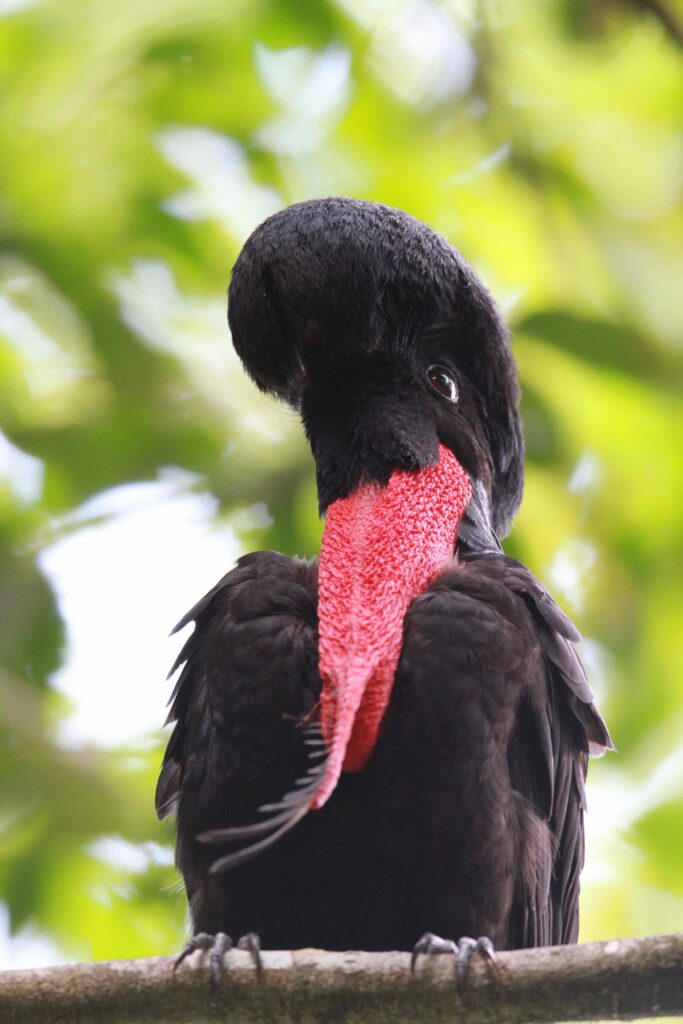
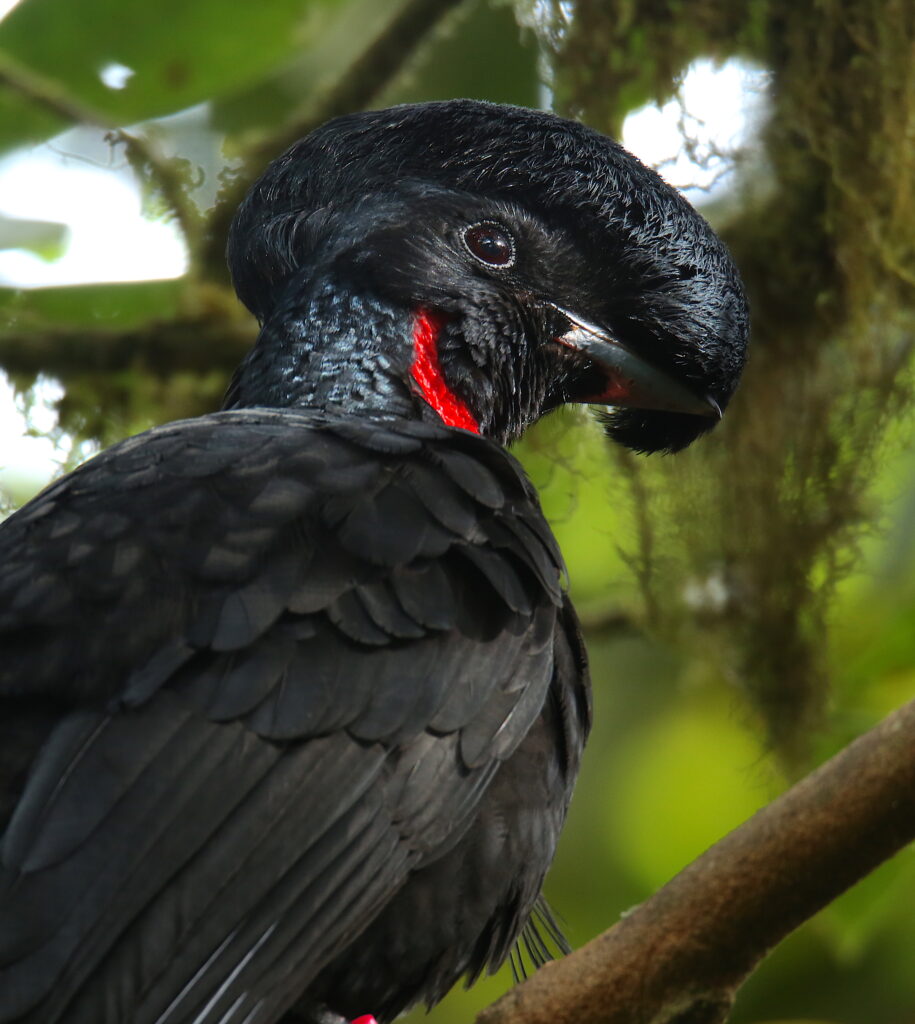
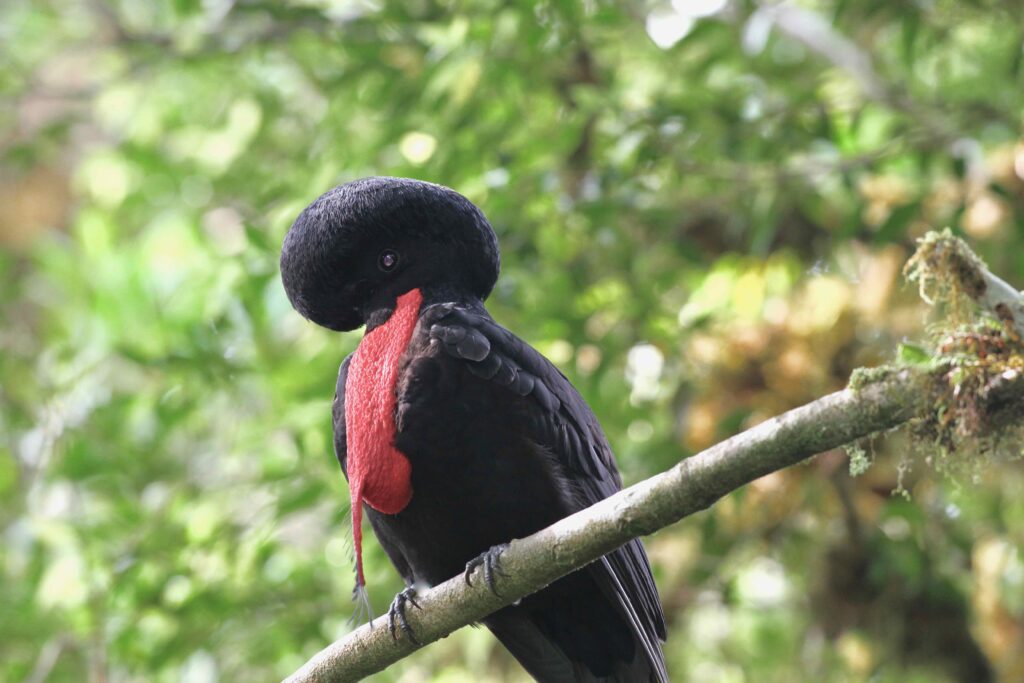
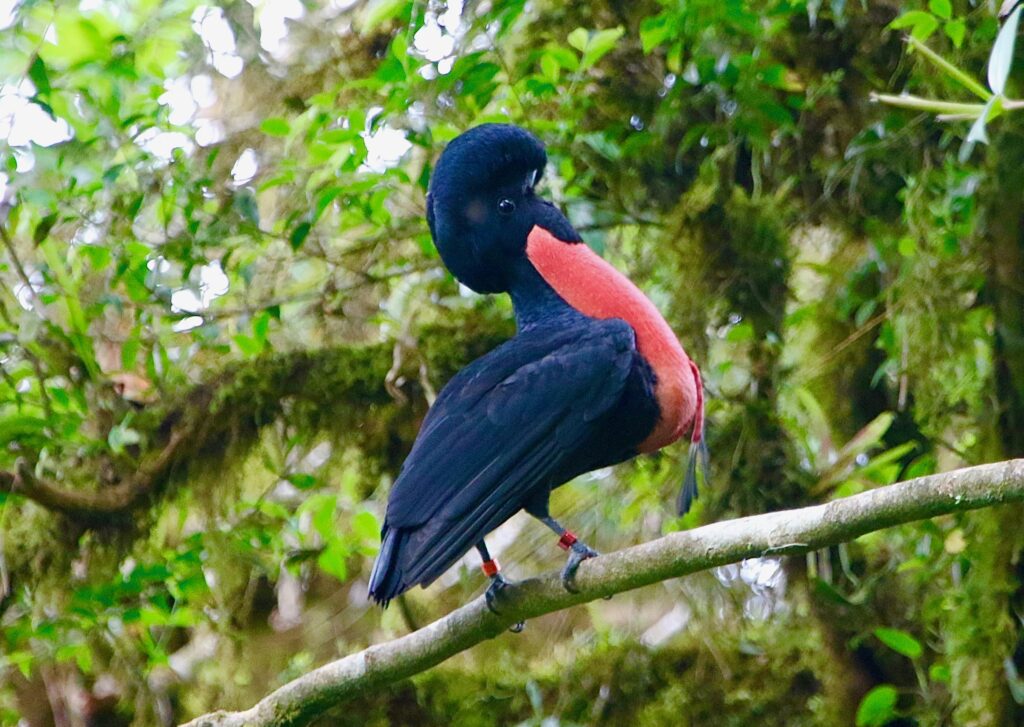
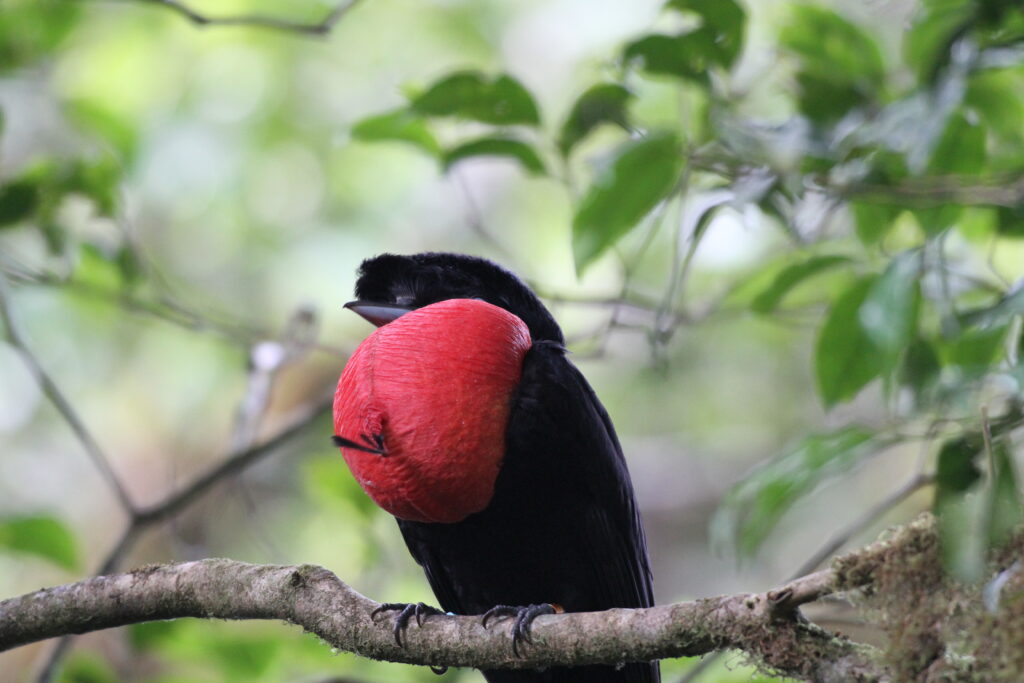
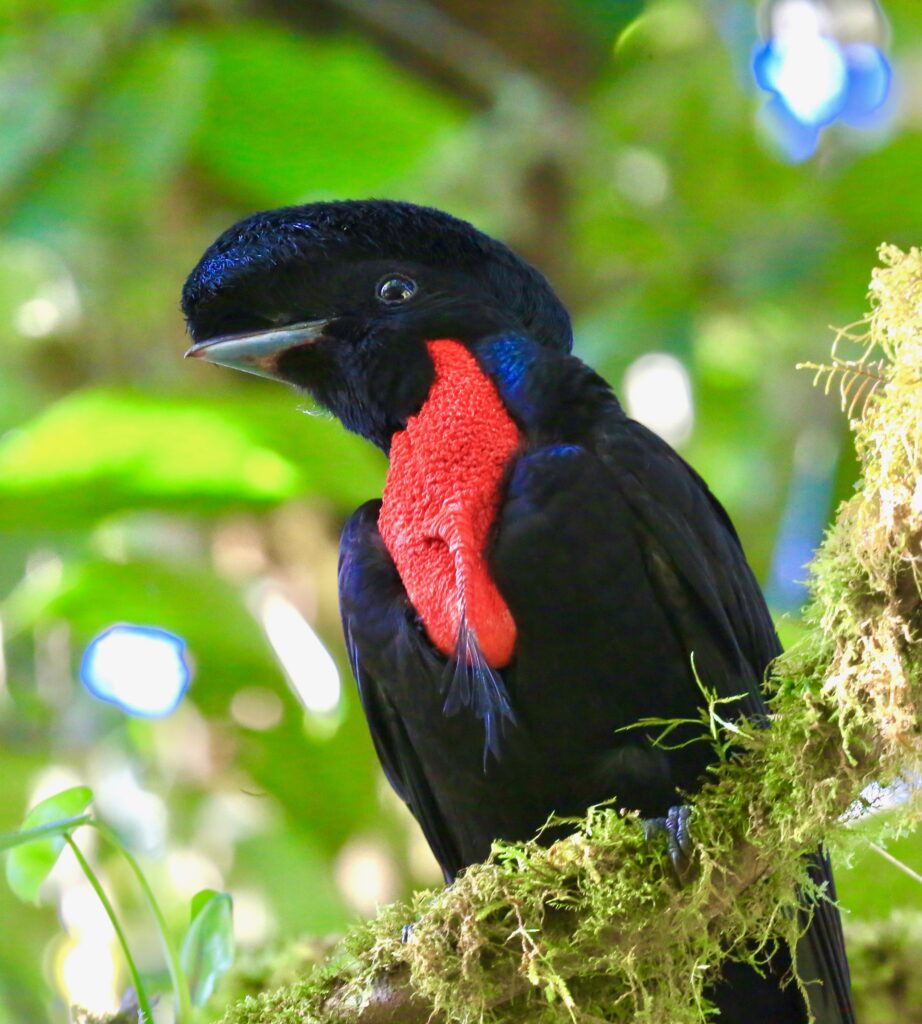
The male Bare-necked Umbrellabird cannot be confused with any other bird you will come upon in Costa Rica. At 40–45 cm and weighing around 550 grams, from a distance, the male Bare-necked Umbrellabird seems to have an all-black plumage. At close inspection, one will find a bluish-black, very mobile crest (which often covers a stout bill having a slight hook on the tip), short rectrices, and broad, brownish wings. At rest, the wing tips extend well beyond the tail.
A large, brilliant red vocal sac of naked flesh runs down the front of the bird and will confirm to any observer that this is the male umbrellabird. This impressive, scarlet-red sac is inflated during his pre-dawn displays at active lek sites and occasionally at feeding areas. Even when relaxed, the sac is still quite visible and boasts a worm-like appendage of flesh containing a collection of minute feathers along its length.
Females are smaller (35–38 cm), paler black around the head and neck, fading to deep brown/black on the belly and under-wings. The females have a much smaller crest than the males. Under close inspection (in the hand), a nearly invisible small red patch of naked flesh is found on the throat. The red patch of a female will often have a few tiny feathers similar to those found on the feathered pouch tassels of the males, but in a greatly reduced size. To the untrained observer in the field, the red patch on a female is not likely to be seen. Female umbrellabirds can be confused with the Purple-throated Fruitcrow (Querula purpurata) when found in the lowlands, as they do share the same habitat.
Altitudinal Migration
Both male and female umbrellabirds are altitudinal migrants, moving up and down slope annually. During their non-breeding season (June to late February), both male and female birds are found in the lower elevations (sea level to 500 meters), returning to the higher elevations (ca. 750 to 2,500 meters) for the breeding season which begins early March and can extend into June.
We have, however, witnessed a few lingering males in the higher elevations as late as early August. The timing of the altitudinal migration of the Bare-necked Umbrellabird seems to be variable depending on fruit availability, as we have been without birds at our study area as late as the middle of April.
Conservation and Research
The Bare-necked Umbrellabird is a very rare, charismatic species with a severely restricted range within Costa Rica. In the early 1990s, this species was listed as Vulnerable and has been in steady decline primarily due to habitat loss within its lower migratory range. Cattle farming and plantation-type agriculture have eliminated or fragmented much of their historic, lower-elevation range. Sadly, much of this deforestation occurred within the last 50 years.
A much more robust reforestation effort must be implemented in the lowlands if Costa Rica is to reverse the downward spiral of this species to extinction. Click on our Conservation and Education tab for information on what UCAN is doing to help and how you can get involved to help save this beautiful bird.
Though the higher altitudes of its range offer plenty of suitable territory for breeding and raising young, previous observations—combined with data we have collected through satellite transmitters and direct observations—suggest these birds do not evenly utilize prime areas for mating, nesting, or even feeding. Lekking and nesting areas are small and widely dispersed, with thousands of hectares of excellent habitat unvisited by both males and females. One of the primary goals of our research is to collect the much-needed data necessary to better understand this unusual behavior.
Species Profile: Cephalopterus glabricollis
| Category | Details |
| Scientific Name | Cephalopterus glabricollis |
| Common Name | Bare-necked Umbrellabird |
| Conservation Status | Endangered / Vulnerable (In steady decline) |
| Male Size | 40–45 cm / ~550 grams |
| Female Size | 35–38 cm / ~320 grams |
| Range | Costa Rica & Western Panama (Caribbean slopes) |
| Migration | Altitudinal (Sea level to 2,500m) |
| Key Features | Inflatable red vocal sac, mobile head crest |
Get in Touch with UCAN
(+33) 7 80 00 08 09
rarebirdsanctuary@gmail.com